Endodontist Coalville – Root Canal Treatment and Specialist Endodontic Care
Root canal treatment, retreatment of failed root fillings, emergency care for severe toothache and the diagnosis of tooth pain — root canal specialist care for Coalville and North West Leicestershire, carried out under magnification with the aim of keeping your natural tooth.
Book an appointment online, or call the practice to speak to someone directly.
Root canal treatment, retreatment and tooth pain care in Coalville
From a first root canal to the rescue of a tooth treated years ago elsewhere, from a cracked molar to a child’s knocked tooth — every service begins with a precise diagnosis and a plan you can take away and read.
Root canal treatment relieves the pain of a dying nerve, removes infection from inside the tooth and keeps the tooth in place. In Coalville it is carried out under magnification with the tooth numbed and isolated — most teeth in a single visit.
A root filling can fail months or years later, but that rarely means the tooth is lost. Retreatment removes the old filling, cleans the canal system thoroughly — including any canal missed first time — and seals and restores the tooth again.
Canals can be finer than a bristle and hidden beneath calcified dentine. The operating microscope gives a bright, magnified view inside the tooth — it is how every root canal treatment and retreatment here is performed.
When infection persists at the root tip and cannot be treated through the crown, a minor procedure under local anaesthetic — an apicectomy — removes the infected root end and seals the canal from the outside. Done under magnification, it is a predictable way to keep a tooth that would otherwise be extracted.
A sudden, sharp pain when biting that disappears as soon as you release is the hallmark of a cracked tooth. Cracks never heal and advance with every meal, so early assessment keeps the most options open for saving the tooth.
A fall, a tackle or a bicycle accident can chip, loosen or knock out a tooth in an instant. What happens in the first hour matters a great deal, and follow-up over the following year protects the nerve inside the tooth.
Toothache often misleads: it can feel as though it comes from the wrong tooth, the other jaw or the ear, and not every ache means a nerve has died. Good care starts with a precise diagnosis.
An infection inside a tooth is cut off from the bloodstream, and therefore from your immune system and from antibiotics. That is why an abscess returns until the tooth itself is treated.
Browse the full list, including microsurgery, cracked tooth assessment, dental trauma care and a second opinion on a tooth you have been advised to remove.
View all treatments
Endodontic care
What an endodontist does — and why it matters for your tooth
Beneath the enamel of every tooth lies a chamber of nerve and blood vessels: the pulp. Decay, a cracked cusp, a deep filling or a blow can let bacteria in, and the pulp responds with the pain and swelling people know as a root canal problem. Untreated, infection passes through the root into the jaw.
Endodontic treatment deals with this hidden part of the tooth. Root canal treatment, retreatment of earlier root fillings, surgery at the root tip and the management of cracks and injuries all share one aim: to clear infection from inside the tooth so that the tooth itself does not have to go.
The practice does only this. Your dentist continues to look after you and places the final crown or filling; we deal with the root canal problem and send them a report of what was done.
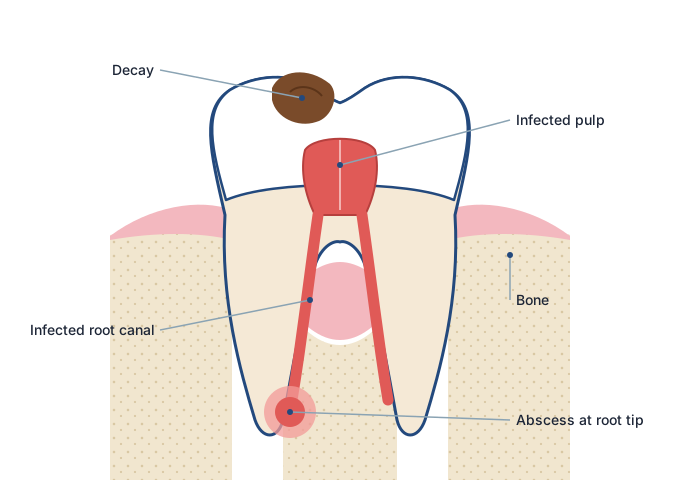
Before treatment: decay has reached the pulp and infection has spread to the bone around the root tip.
Step by step
What happens, from first call to finished tooth
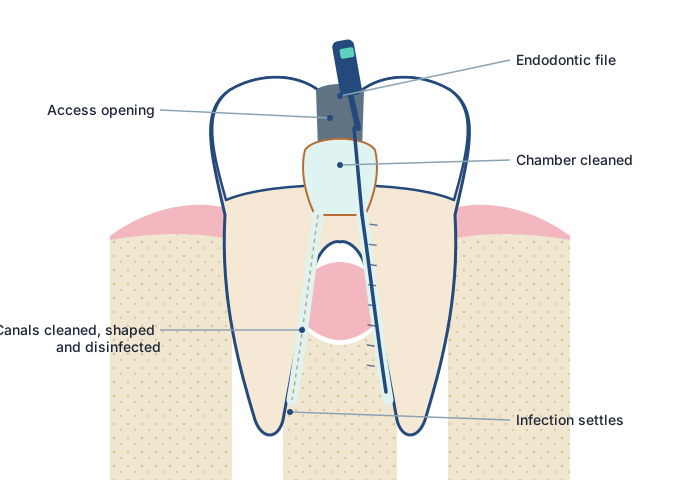
During treatment: the infected tissue is removed and the canals are cleaned, shaped and disinfected under the microscope.
Assessment
We hear how the pain behaves, examine and test the teeth and take the X-rays needed to confirm the cause. Bring your dentist’s recent X-rays if you have them.
Written plan
The findings, the recommended treatment, its likely success and the fee are explained and given to you in writing. You decide when to proceed.
Treatment visit
With the tooth numb and isolated, the canals are measured, cleaned, disinfected and sealed under magnification — most teeth in a single appointment.
Restoration and review
Your dentist places the protective crown or filling from our report, and healing of the bone is checked at a later review.
Cold and bite tests and the right X-rays identify the tooth and the problem before anything is done. If the pain is not endodontic, we say so.
Magnification as routine
Canals are fine, curved and easy to miss. Treating every tooth under magnification means they are found, cleaned fully and sealed — which is what makes a root filling last.
Your own tooth, wherever possible
A tooth that can be restored predictably is worth keeping. We assess that candidly and recommend extraction only when it is genuinely the better option.
Current technique for every tooth
Electronic root measurement, flexible instruments, activated irrigation and modern sealing materials are used routinely, not just for complex cases.
Everything in writing
You leave your consultation with the diagnosis, the options, the realistic prospects for the tooth and the fee on paper — and the decision is yours.
Care for nervous patients
Anaesthetic checked before we begin, breaks whenever you need them and appointments long enough that no one is rushed. Tell us what would help.
Precision matters
Seeing clearly inside a tooth is the difference between a root filling that lasts and one that fails
The canals of a molar can be narrower than a bristle, bend sharply and split into branches. Most root fillings that fail do so because a canal was missed, cleaned short or sealed poorly — problems of visibility, not of effort.
Magnification with bright, direct light shows the floor of the tooth in detail: hidden canal entrances, hairline cracks and old filling material all become visible, and the access cavity can stay small.
Electronic measurement locates the end of each root to within a fraction of a millimetre, flexible instruments follow the natural curve and activated irrigation carries disinfectant into side branches that no file can reach.
The equipment does not decide anything. Diagnosis and honest judgement about the tooth’s prospects come first; precision then carries out the plan.
Severe toothache or a swelling? You should be seen, not left waiting
Pain that throbs on its own, lingers after something hot or wakes you in the small hours points to a nerve that is inflamed or dying. Painkillers blunt it for a while but do not fix it, and an abscess left alone can spread.
Say that your symptoms are urgent when you contact us. We arrange the earliest appointment we can, relieve the pain at that visit and complete the treatment calmly afterwards.
Go straight to medical care if a swelling is spreading quickly, you have difficulty swallowing or breathing, or you feel very unwell — call NHS 111 or go to A&E.
Advised to have a tooth removed? It may well be saveable
An abscess, a failed root filling or a canal another clinician could not negotiate is not, by itself, the end of a tooth. A great many teeth written off as hopeless can be treated or retreated and kept for years.
Some, however, cannot — a root split from top to bottom, or too little sound tooth left to hold a crown. In those cases we tell you plainly, because treating a tooth with poor prospects does you no favours.
You receive a written assessment of the realistic options and the likely success of each, so that whatever you decide, you decide it knowingly.
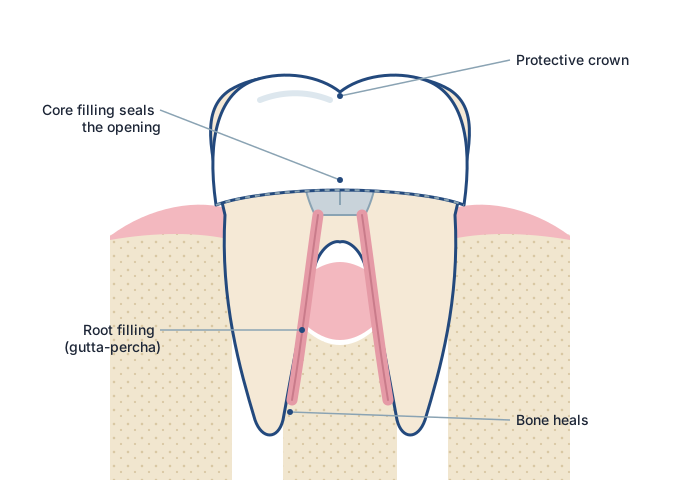
After treatment: the canals are sealed, the opening is filled and a crown protects the tooth while the bone heals.
MSc Endodontics
About us
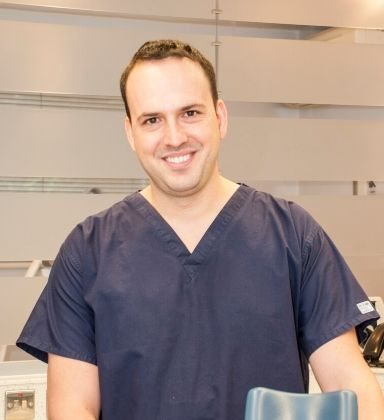
Angel Ognemirov — the endodontist behind the practice
Angel Ognemirov completed an MSc in Endodontics at the University of Chester and trained in oral and intravenous dental sedation at Guy's Hospital in London. He also holds a certificate in Restorative Dentistry and is a member of the Society for the Advancement of Anaesthesia in Dentistry (SAAD).
A large part of his work is with patients for whom the dentist is a source of genuine dread. The answer is practical: appointments that are never rushed, a clear explanation before each step, anaesthetic checked before anything begins and the freedom to stop whenever you need to. People who have stayed away for years are treated without a word of judgement.
Clinically, the priority is an accurate diagnosis and a fair chance for every tooth — magnification for each root canal, current technique as standard and an honest written opinion of what the tooth can be expected to do. Patients come from Coalville and across North West Leicestershire, referred by their dentist or directly.
MSc in Endodontics, University of Chester
Training in oral and intravenous dental sedation, Guy's Hospital, London
Certificate in Restorative Dentistry
Member of SAAD (Society for the Advancement of Anaesthesia in Dentistry)
Not when the tooth is properly numbed — and we check before we start. You feel pressure and vibration, not pain, and if anything sharp comes through we stop and top up the anaesthetic. The tooth may feel bruised for two or three days afterwards.
How long does the appointment take?
Usually 60 to 90 minutes. Most of that is spent cleaning each canal to its full length, which is what determines whether the treatment lasts.
Is it done in one visit?
Often, yes. A heavily infected tooth, a retreatment or unusual anatomy may be dressed with medication and finished at a second visit a week or two later.
Why treat under magnification?
Because the canal openings are tiny and hidden. An upper molar frequently has a fourth canal that is missed without magnification, and a missed canal is the commonest cause of a root filling failing.
My root canal was done years ago and now hurts. Can it be fixed?
Usually, by retreatment: the old filling is removed, any missed or re-infected canals are cleaned and the tooth is sealed again. If the root tip cannot be reached from inside, microsurgery is the alternative.
Can an abscessed tooth be saved?
In the majority of cases. Clearing the infected tissue from the canals and sealing them allows the bone around the root to heal. A split root or too little remaining tooth are the exceptions, and we will tell you which applies.
What should I expect afterwards?
Mild tenderness for a few days, eased by ordinary painkillers. Your dentist then fits the final crown or filling, ideally within a few weeks, and healing is checked on an X-ray at review.
Will the tooth need a crown?
Most back teeth do: without cuspal coverage a root-treated molar is prone to cracking. Some front teeth can be restored with a filling. Our report to your dentist includes the recommendation.
Does toothache always mean the nerve?
No. Cracked cusps, gum problems, sinus congestion and jaw muscle pain can all feel like toothache, and pain is often felt in the wrong tooth. Testing before treating protects you from treating the wrong one.
How do I know if there is an infection?
Tenderness on biting, a swelling or a gum boil, a bad taste or a darkened tooth are common signs — though many infections are silent and found on a routine X-ray. Pain that suddenly stops usually means the nerve has died, not healed.
What makes someone a root canal specialist?
In the UK the word “specialist” is protected: it may be used only by dentists on the General Dental Council’s specialist list for endodontics. Whoever treats you, it is fair to ask how much of their work is root canal treatment and how it is carried out.
What if I ignore an infected tooth?
The infection remains in the bone and can flare or spread. Symptoms often come and go, which is deceptive, and the longer it is left the harder the tooth becomes to save.
Contact
Book an appointment in Coalville
Referred by your dentist, looking for a second opinion or in pain right now — get in touch and we will find you the earliest suitable time. Mention urgent symptoms and you will be prioritised.